
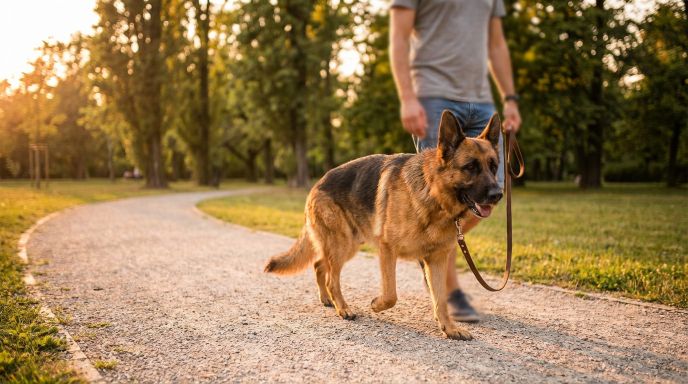
Does your German Shepherd drag you down the street like you’re waterskiing on dry land? Do you dread walks because your 80-pound dog has the pulling power of a sled team? You’re not alone.
German Shepherd owners across the world share the same frustration: a powerful, intelligent dog who seems to think walks are a competitive sport where the goal is to reach the next lamppost in record time. Your arm aches, your shoulder hurts, and you’ve tried everything—but nothing seems to work.
Here’s the truth: your German Shepherd isn’t trying to dominate you or be stubborn. They’re just doing what centuries of breeding programmed them to do—work, move, and explore with intense drive and purpose. The good news? With the right approach, you can transform your strong-willed GSD into a pleasant walking companion.
This guide provides a proven 5-stage system specifically designed for German Shepherds. You’ll learn why GSDs pull more than other breeds, what equipment actually works, age-specific training strategies, and troubleshooting solutions when progress stalls.
Realistic timeline: With consistent daily practice, most German Shepherds achieve reliable loose-leash walking in 8-16 weeks. Adolescent dogs (6-18 months) may take longer, but the investment is worth it.
Let’s get started.
- Why German Shepherds Are Notorious Leash Pullers
- Essential Equipment for German Shepherd Leash Training
- The 5-Stage German Shepherd Leash Training Method
- Age-Specific Leash Training Guidance
- Common Leash Training Mistakes (And How to Avoid Them)
- Troubleshooting: When Training Isn’t Working
- When to Seek Professional Help
- Real-World Walking Strategies for German Shepherds
- Your 90-Day Leash Training Action Plan
- Frequently Asked Questions
- Conclusion
- Related Resources
Why German Shepherds Are Notorious Leash Pullers
Before you can fix pulling, you need to understand why German Shepherds do it more than other breeds.
Breed-Specific Traits That Cause Pulling
Working dog heritage: German Shepherds were bred to herd livestock, patrol property, and work alongside handlers for hours every day. Their genetics tell them to move with purpose and cover ground efficiently. A leisurely stroll around the block? That’s not in their DNA.
High prey drive: Movement triggers chase instinct. Squirrels, joggers, bikes, leaves blowing in the wind—all of these activate your GSD’s hardwired prey drive. When they see something moving, their brain floods with excitement, and your voice becomes background noise.
Intelligence + Independence: German Shepherds are problem-solvers. They quickly figure out that pulling gets them where they want to go faster. If pulling works even occasionally, they’ll keep doing it. They’re not being defiant—they’re being logical.
Adolescent testing phase: Between 6 and 18 months, German Shepherds go through a teenage phase where impulse control is still developing. This is when pulling often gets worse, even if your dog was walking nicely at 5 months old.
Excitement and overstimulation: The outside world is endlessly fascinating to a German Shepherd’s intelligent mind. Every smell tells a story, every sound deserves investigation. Self-control is hard when the world is this interesting.
The Physical Challenge
Let’s talk about the raw power issue. Adult male German Shepherds typically weigh 65-90 pounds and can generate 80-100 pounds of pull force when motivated. Female GSDs weigh 50-70 pounds but are still significantly stronger than most human handlers.
This creates a genuine safety risk. Small handlers, children, and elderly family members simply cannot physically control an untrained German Shepherd who decides to lunge after a squirrel. This isn’t just about convenience—it’s about preventing injuries.
Key takeaway: Pulling isn’t defiance or dominance. It’s instinct, excitement, and genetics. Your job is to redirect that energy into walking beside you instead of dragging you forward.
Essential Equipment for German Shepherd Leash Training
The right equipment makes training significantly easier—but remember, equipment doesn’t replace training. It’s a tool, not a solution.
Leash Options
✅ Standard 6-foot leash (Best choice)
A standard 6-foot leash made of leather or nylon is the gold standard for training. Here’s why:
- Consistent length teaches your dog exactly how much space they have
- Leather is incredibly durable for strong pullers
- Nylon is lightweight and easy to clean
- You have optimal control without excessive length
❌ Retractable leashes (Never for training)
Retractable leashes are popular, but they actively sabotage leash training:
- They teach dogs that pulling = more freedom (the leash extends when they pull)
- Inconsistent tension confuses your dog
- Safety hazards: leashes can snap, handles can slip, thin cord can cause rope burns
- No control in emergency situations
Never use a retractable leash during training. Save it for after your dog has mastered loose-leash walking—if you use one at all.
Collar vs. Harness: Which Is Best?
This is one of the most debated topics in dog training. Here’s the practical breakdown:
Front-Clip Harness (Best for most GSD owners)
A front-clip harness attaches the leash at your dog’s chest. When they pull forward, the harness redirects their momentum to the side, creating a steering effect that naturally discourages pulling.
Advantages:
- Reduces pulling by 30-40% through mechanical advantage
- Eliminates choking and throat pressure
- Safer for dogs with trachea or neck issues
- Easier for small handlers to control large dogs
Popular options: Freedom Harness, Easy Walk Harness, PetSafe 3-in-1 Harness
For detailed reviews of specific harness brands and sizing guides, visit GSDGearLab.com.
Back-Clip Harness (NOT for pulling problems)
Back-clip harnesses attach the leash between the shoulder blades. These are designed for sled dogs—they’re literally engineered to help dogs pull more efficiently.
Only use a back-clip harness after your German Shepherd has completely mastered loose-leash walking.
Flat Collar or Martingale Collar
Traditional flat collars work well for dogs who already have good leash manners. Martingale collars (limited-slip collars) are excellent for German Shepherds because they prevent slipping out—important for escape artists—while still being safe.
These are good choices once your dog is trained, but they don’t offer the mechanical advantage of a front-clip harness during the training phase.
Prong Collars & E-Collars (Controversial)
Prong collars (pinch collars) and e-collars (electronic/shock collars) are controversial training tools that require professional guidance to use correctly. They’re not recommended for beginners or basic leash training for several reasons:
- High risk of physical injury or psychological damage if misused
- Can create fear-based compliance instead of understanding
- Not necessary for basic loose-leash walking
If you’re interested in advanced training tools, consult a certified professional trainer who specializes in German Shepherds. For information on advanced training techniques, visit GSDSmarts.com.
Training Treats & Rewards
Your treats need to be more interesting than the environment. That means high-value rewards:
Best treat options:
- Small pieces of cooked chicken (pea-sized)
- Cheese cubes (sharp cheddar works great)
- Hot dog slices (cut into tiny pieces)
- Freeze-dried liver (extremely high-value)
What doesn’t work:
- Regular kibble (too boring)
- Large treats (take too long to eat)
- Hard treats (require chewing, breaks focus)
Pro tip: Use a treat pouch attached to your waist for hands-free access. You’ll need both hands available during training sessions.
Equipment Checklist
Before starting training, gather:
- 6-foot standard leash (leather or nylon)
- Front-clip harness (properly fitted)
- High-value training treats
- Treat pouch for hands-free carrying
- Clicker (optional but helpful)
The 5-Stage German Shepherd Leash Training Method
This progressive system builds skills step-by-step. Each stage prepares your GSD for the next level. Don’t skip stages—that’s the most common reason training fails.
STAGE 1: Collar & Leash Introduction (Puppies 8-12 Weeks)
Goal: Get your puppy comfortable wearing a collar and leash without fear, resistance, or viewing it as a toy.
Steps:
- Introduce the collar: Let your puppy sniff the collar first. Put it on during mealtime or play sessions—times when your puppy is already happy and distracted.
- Supervise wearing time: Your puppy will probably scratch at the collar. This is normal. Just like wearing a watch feels strange at first, the sensation of something around their neck takes getting used to.
- Remove strategically: Only take the collar off when your puppy is calm and has forgotten about it. Never remove it while your puppy is fussing—that rewards the fussing behavior.
- Add the leash: Once your puppy ignores the collar, attach a lightweight leash and let them drag it around indoors while supervised. This gets them used to the feeling of something trailing behind them.
- Prevent leash-chewing: Redirect your puppy’s attention with toys and play if they start chewing the leash. You can also apply Bitter Apple spray, but you’ll need to reapply it frequently.
Timeline: 3-7 days until your puppy completely ignores wearing the collar and leash.
Critical safety warning: Never leave a collar or leash on an unattended puppy. Collars can catch on objects and cause strangulation. Supervision is mandatory.
For adult dogs: If your German Shepherd is already comfortable wearing a collar, skip to Stage 2.
STAGE 2: Indoor Foundation Training (Weeks 1-2)
Goal: Teach the fundamental concept that “loose leash = we move forward” in a completely distraction-free environment.
Where to train: Inside your home—hallway, living room, or kitchen.
Steps:
- Attach the leash and hold it loosely at your waist. Don’t extend your arm—keep your elbow bent at your side.
- Take one step and say “Let’s go” in a cheerful, encouraging voice.
- If the leash stays loose: Immediately praise (“Yes! Good!”) and give a treat. Take another step.
- If the leash goes tight: Stop walking immediately. Stand completely still. Don’t say anything. Don’t pull back on the leash.
- Wait. Your dog will eventually look at you, back up, or create slack in the leash. The moment they do—even slightly—praise and give a treat, then resume walking.
- Practice 5-10 minutes, three times daily. Short, frequent sessions work better than long ones.
Training tips:
- Reward every 2-3 steps at first. This seems excessive, but it builds the behavior quickly.
- Use an excited, happy voice. Your energy affects your dog’s engagement.
- Keep training sessions fun. If you’re frustrated, your dog will sense it.
Common mistakes:
❌ Pulling back when your dog pulls forward: This creates opposition reflex—your dog pulls harder because you’re pulling.
❌ Repeating “Let’s go” constantly: Say it once. If you repeat commands endlessly, you teach your dog they don’t have to respond the first time.
❌ Training sessions that are too long: Puppies and young dogs lose focus after 5-10 minutes. Multiple short sessions beat one long session.
Success benchmark: Your dog can walk beside you for 30 feet indoors without pulling, looking away, or losing focus.
STAGE 3: Backyard & Low-Distraction Practice (Weeks 3-6)
Goal: Generalize loose-leash behavior to a new environment with mild distractions like smells, birds, and outdoor sounds.
Where to train: Your fenced backyard, driveway, or a quiet cul-de-sac.
Steps:
- Start each session with a 2-minute warm-up: Review what your dog learned indoors. This gets them in “training mode.”
- Walk in your backyard using the same rules: Loose leash = we move forward. Tight leash = we stop immediately.
- Reward check-ins: Any time your dog voluntarily looks at you without being prompted, give them a “jackpot” reward (multiple treats + extra praise). This teaches them that paying attention to you is highly rewarding.
- Introduce direction changes: Suddenly turn right or left without warning. When your dog catches up and walks beside you again, reward heavily.
- Add mild distractions gradually: Have a family member stand in the yard. Place a toy on the ground (but don’t let your dog interact with it yet). Practice walking near these distractions while maintaining loose-leash walking.
- Practice 10-15 minutes, twice daily.
Troubleshooting:
Problem: My dog pulls toward every smell and distraction.
Solution: You’ve increased difficulty too quickly. Go back to Stage 2 for a few days, then retry Stage 3 with shorter 5-minute sessions. Also, upgrade your treats—if you’re using kibble, switch to real chicken or cheese.
Problem: My dog walks perfectly for 5 minutes, then starts pulling.
Solution: This is attention fatigue. End your training session before your dog gets tired. It’s better to do three 5-minute sessions throughout the day than one 15-minute session where the last 10 minutes are a struggle.
Age-specific note for adolescent GSDs (6-18 months):
Expect regression during adolescence! Your dog may have walked perfectly at 5 months old, then suddenly act like they’ve never seen a leash at 9 months. This is completely normal—it’s brain development, not defiance.
The adolescent brain is still forming impulse control. It’s like human teenagers—they know the rules, but their brains haven’t fully developed the ability to consistently follow them.
Solution: Return to Stage 2 for a week, then retry Stage 3 with even higher-value rewards. Increase patience. This phase passes—usually by 18 months, behavior improves dramatically.
Success benchmark: Your dog can walk 100+ feet in your backyard without pulling and ignores mild distractions like birds or family members nearby.
STAGE 4: Real-World Walking with Distractions (Weeks 7-12)
Goal: Practice loose-leash walking in public environments with real distractions—other dogs, people, squirrels, bikes, and traffic sounds.
Where to train: Neighborhood sidewalks, quiet park trails, empty parking lots (during off-peak hours like early morning).
Steps:
- Start in the least-distracting location possible. An empty parking lot at 6 AM is perfect. You want your dog to succeed, and that means controlling the difficulty level.
- Begin with a 2-minute easy warm-up walk to get your dog focused.
- Practice the “Stop & Go” technique:
- The instant the leash goes tight, stop walking
- Don’t say anything. Don’t jerk the leash. Just be a tree.
- Wait. This might take 30 seconds or 2 minutes.
- When your dog looks at you OR creates slack in the leash, immediately praise, treat, and resume walking.
- Add the “Direction Change” technique:
- When your dog starts pulling, turn 180 degrees and walk in the opposite direction
- Your dog must catch up to you (the leash going tight in a new direction provides a natural correction)
- When they reach your side, reward heavily
- Reward heavily for ignoring distractions: If your dog sees a squirrel but looks at you instead of pulling? That deserves a jackpot reward—multiple treats and enthusiastic praise.
Handling Common Distractions:
Other dogs approaching:
This is one of the biggest challenges for German Shepherd owners. Many GSDs are reactive or overly excited when they see other dogs.
- Create distance by crossing the street if needed
- Practice “Watch me” command—your dog looks at your eyes, gets a treat
- If your dog pulls or lunges: Stop immediately, wait for calm behavior, then reward the calm
For dogs with serious leash reactivity toward other dogs, check out our articles on German Shepherd Socialization or visit RebuildYourShepherd.com for specialized reactivity rehabilitation.
Squirrels and prey animals:
Expect pulling—prey drive is incredibly strong in German Shepherds. Their herding heritage means chasing movement is instinctual.
- Practice at a distance first (50+ feet from squirrels)
- Use an emergency recall sound (whistle) paired with your absolute best reward
- Gradually decrease distance over weeks as your dog improves
- Never expect perfection—even trained GSDs will want to chase prey
Bikes, joggers, and skateboards:
Fast-moving objects trigger both prey drive and herding instincts.
- Position yourself between your dog and the trigger when possible
- Reward before your dog reacts (proactive, not reactive)
- Practice in environments where you can control distance
- Start far away (100 feet) and gradually decrease distance over weeks
Real-world example:
Sarah’s 10-month-old German Shepherd, Max, would lunge and bark at every jogger. She started training at 6 AM when joggers were rare. Each time Max saw a jogger 100 feet away and looked at Sarah instead of lunging, he received a piece of chicken. After 3 weeks of consistent practice, Max could pass joggers at 10 feet without pulling. It took patience, but the payoff was a dog she could safely walk.
Success benchmark: Your dog can complete a full neighborhood loop (20-30 minutes) with only occasional pulling and recovers quickly when you stop or change direction.
STAGE 5: Advanced Walking & Maintenance (Months 4+)
Goal: Maintain loose-leash walking long-term in all environments and situations.
Strategies for long-term success:
Variable reward schedule: Stop treating every single time your dog walks nicely. Start rewarding randomly—sometimes every 10 steps, sometimes every 50 steps. This keeps your dog guessing and actually strengthens the behavior.
Introduce the “Heel” command: “Heel” is different from loose-leash walking. Heel means your dog walks directly at your left side with focused attention. This is useful for crowded sidewalks, crossing streets, or situations requiring maximum control. For advanced heel training techniques, visit GSDSmarts.com.
Practice in high-distraction environments: Once your dog masters neighborhood walks, challenge them with busier areas—outside the fence at dog parks, farmers markets, downtown areas. Always set your dog up for success by starting at a distance and gradually moving closer.
Never stop training completely: Even adult German Shepherds need occasional refresher sessions. Life changes, environments change, and your dog will encounter new situations. Plan for 1-2 challenging walks per week to keep skills sharp.
Long-term maintenance tip: If you notice pulling creeping back in, don’t panic. Go back to Stage 3 or 4 for a few days, reinforce the fundamentals, then return to your normal routine.
Age-Specific Leash Training Guidance
German Shepherds at different life stages need different approaches. What works for a 3-month-old puppy won’t work for a 12-month-old adolescent.
Puppies (8 Weeks – 6 Months)
Training focus: Foundation building and creating positive associations with walks.
Timeline: 8-12 weeks to master basic loose-leash walking indoors and in low-distraction outdoor areas.
Tips for puppy training:
- Keep sessions very short (5 minutes maximum). Puppies have short attention spans.
- Socialize during walks—let your puppy meet friendly people and calm, well-behaved dogs
- Avoid over-exercising. Long walks can damage developing joints. The general rule: 5 minutes of exercise per month of age, twice daily (so a 4-month-old puppy gets two 20-minute walks daily maximum).
- Make everything fun. Puppies learn through play, not strict discipline.
Adolescents (6-18 Months) – THE HARDEST PHASE
The challenge: This is when many owners give up on leash training. Your dog was perfect at 5 months, then suddenly acts like they’ve never met you.
Why pulling worsens during adolescence:
- Hormonal changes affect behavior and impulse control
- Brain development—the prefrontal cortex (decision-making center) is still forming
- Independence testing—adolescent dogs push boundaries like human teenagers
- Increased prey drive and excitability
Strategies for surviving adolescence:
Increase reward value dramatically. Those treats that worked at 4 months won’t cut it anymore. Upgrade to the best rewards your dog has ever tasted.
Shorten training sessions. Adolescent attention spans are shorter than puppy attention spans (yes, really). Go back to 5-minute sessions.
Expect setbacks and don’t get discouraged. Regression is normal. Your dog isn’t being defiant—their brain is literally under construction.
Consistency is everything. Every family member must enforce the same rules. Adolescent dogs will exploit any inconsistency.
Consider a professional trainer if pulling becomes dangerous or you feel unsafe. This is an investment in years of enjoyable walks.
Real-world perspective: Many German Shepherd owners report that 9-12 months is the absolute worst age for pulling. But almost everyone says behavior improves dramatically after 18 months. Push through—it gets better!
Adults (18 Months+)
The challenge: Breaking established bad habits in adult dogs requires patience and consistency.
Timeline: 12-16 weeks to retrain an adult German Shepherd with no prior training.
Strategies for adult dog training:
- Start at Stage 2—don’t skip steps. Even adult dogs need to learn the fundamentals in low-distraction environments first.
- Be patient. Unlearning is harder than learning. Your dog has practiced pulling for months or years—it’s a deeply ingrained habit.
- Front-clip harness is essential. Adult GSDs are strong. You need mechanical advantage.
- Celebrate small wins. If your dog used to pull for 90% of the walk and now pulls for 70%, that’s real progress. Acknowledge it.
- Stick with it. Adult dogs can absolutely learn new behaviors—it just takes longer than puppy training.
Common Leash Training Mistakes (And How to Avoid Them)
Even well-intentioned owners make these errors that sabotage months of progress. Learn from others’ mistakes:
1. Using Retractable Leashes
Why it fails: Retractable leashes literally teach your dog that pulling = more freedom. The leash extends when they pull, rewarding the exact behavior you’re trying to eliminate.
Solution: Switch to a standard 6-foot leash for all training and daily walks.
2. Inconsistent Rules Between Family Members
Why it fails: Your dog gets confused. Mom stops walking when I pull, but Dad doesn’t. Your teenager lets the dog sniff everything, but you don’t. This inconsistency makes training take 3-4 times longer.
Solution: Hold a family meeting. Everyone must agree to enforce the exact same rules. Post the rules on the refrigerator if needed.
3. Only Training in One Location
Why it fails: Dogs don’t automatically generalize behavior. Your GSD might walk perfectly in your backyard but pull like a freight train at the park because they haven’t learned that the rules apply everywhere.
Solution: Train in at least 5 different environments—backyard, driveway, neighborhood, park, downtown. Start easy, gradually increase difficulty.
4. Low-Value Rewards
Why it fails: Kibble cannot compete with squirrels, other dogs, or fascinating smells. Your treats must be more interesting than the environment.
Solution: Use real food—chicken, cheese, hot dogs. Save the best rewards for the hardest distractions.
5. Pulling Back When Your Dog Pulls Forward
Why it fails: This creates opposition reflex—a natural instinct where pressure causes your dog to push back harder. It’s why sled dogs can pull heavy loads.
Solution: Stop walking instead of pulling back. Become a tree. Wait for slack, then reward and resume.
6. Punishing After the Fact
Why it fails: Dogs live in the moment. If you scold your dog 30 seconds after they pulled, they don’t connect the punishment to the pulling. They just know you’re suddenly angry.
Solution: Address behavior in the moment. Stop immediately when pulling happens. Reward immediately when walking nicely resumes.
7. Expecting Overnight Results
Why it fails: Leash training takes 8-16 weeks of consistent daily practice. Expecting perfection after two weeks sets you up for disappointment and giving up.
Solution: Track progress weekly instead of daily. Celebrate improvements—”Last week, my dog pulled for 80% of the walk; this week it’s 60%. Progress!”
Troubleshooting: When Training Isn’t Working
Stuck? Here’s how to diagnose and fix common problems.
Problem 1: My German Shepherd Completely Ignores Me Outside
Possible causes:
- Distractions are way too high for your dog’s current skill level
- Your treats aren’t exciting enough
- Your dog is over-threshold (too stimulated to think clearly)
- You skipped earlier training stages
Solutions:
- Train at 6 AM or late evening when the world is quieter
- Upgrade to freeze-dried liver or real chicken
- Practice “Watch me” command at home until it’s automatic
- Reduce walk distance—five minutes of focused training beats 30 minutes of pulling
- Go back to Stage 3 and rebuild foundation
Problem 2: Pulling Gets Worse Before It Gets Better
Why this happens: This is called an “extinction burst.” When a behavior that previously worked (pulling) suddenly stops working, your dog tries harder before giving up. It’s like pushing a broken elevator button repeatedly—you push harder, more frequently, before accepting it’s broken.
Solutions:
- This is completely normal! Don’t give up.
- Stay absolutely consistent. One instance of giving in resets all your progress.
- Temporarily increase reward frequency to help your dog through this phase
- Remind yourself: This is a sign training is working, not failing
Problem 3: My GSD Is Leash Reactive (Barking/Lunging at Other Dogs)
This goes beyond basic pulling: Leash reactivity requires specialized training that’s outside the scope of this guide.
Immediate strategies:
- Increase distance from triggers—cross the street, turn around
- Practice “Look at That” game: Reward your dog for calmly noticing another dog
- Never allow your dog to “greet” while reactive—this rewards the behavior
- Keep walks short and controlled until reactivity improves
When to seek professional help:
- Reactivity escalates to aggression (snapping, biting)
- You feel unsafe walking your dog
- No improvement after 4 weeks of consistent practice
- Other people or dogs have been injured
For severe leash reactivity and aggression issues, visit RebuildYourShepherd.com for specialized rehabilitation programs.
Problem 4: Small Children or Elderly Family Members Need to Walk the Dog
Safety must come first. An untrained German Shepherd can easily pull down a child or elderly person, causing serious injury.
Solutions:
- Use a front-clip harness (reduces pulling by 40%)
- Practice in backyard first until dog is reliable
- Walk during low-distraction times (early morning)
- Two-person walks during training (adult + child both hold leash)
- Teach “Emergency Stop” command: Dog must sit immediately if they pull
- Be realistic: Young children (under 12) should not walk a German Shepherd alone until the dog is fully trained
When to Seek Professional Help
Some situations require expert guidance. Don’t wait until someone gets hurt.
Signs You Need a Professional Trainer:
✅ Your German Shepherd has pulled you down or caused physical injury
✅ Leash aggression or reactivity toward people or other dogs
✅ No improvement after 8+ weeks of consistent daily training
✅ You feel unsafe or anxious walking your dog
✅ Multiple family members cannot control the dog
✅ Adolescent GSD (6-18 months) with dangerous pulling behavior
✅ Your dog has bitten or attempted to bite another dog or person on leash
How to Find a Good Trainer:
Look for certifications: CPDT-KA (Certified Professional Dog Trainer), CBCC-KA (Certified Behavior Consultant Canine). These credentials require education, experience, and passing rigorous exams.
Ask about training methods: A good trainer uses positive reinforcement combined with clear boundaries and structure. Avoid trainers who rely solely on punishment, use outdated “dominance” theory, or promise instant results.
German Shepherd experience is essential: Generic dog trainers may not understand breed-specific drives, working dog mentality, or GSD adolescent behavior patterns.
Group classes vs. private training:
- Group classes: Good for socialization and basic skills. Cost: $150-300 for 6-week course.
- Private training: Better for reactivity, aggression, or severe pulling. Cost: $75-150 per session.
Specialized Resources:
For severe behavioral issues including aggression, fear-based reactivity, or rehabilitation needs: RebuildYourShepherd.com
For advanced obedience training, competition preparation, or working dog development: GSDSmarts.com
Real-World Walking Strategies for German Shepherds
Once your basics are solid, these strategies make everyday walks even better.
Multi-Dog Household Tips
Walking multiple German Shepherds (or a GSD plus other dogs) requires extra strategy:
- Train each dog individually first. Don’t attempt multi-dog walks until each dog can walk nicely alone.
- Practice parallel walking: Two handlers, dogs start 10 feet apart, gradually decrease distance over weeks.
- Reward calm behavior around each other. Any time dogs walk without fixating on each other = treat.
- One leash per handler until both dogs are reliable. Never walk two large dogs on a coupler leash.
Walking in Different Environments
Urban sidewalks:
- Use “Heel” command for crowded areas where your dog needs to stay close
- Position your dog away from the street (safety from cars)
- Reward heavily for ignoring high distractions (people, storefronts, food smells)
Parks and trails:
- Allow sniffing breaks as rewards (mental stimulation is important!)
- Consider a long line (15-30 feet) in safe, enclosed areas for supervised freedom
- Practice recall before allowing any off-leash time
Busy areas (farmers markets, downtown, festivals):
- Only attempt after completely mastering Stage 5
- Bring your highest-value rewards
- Take mental breaks—find quiet spots for your dog to decompress
- Watch for signs of overstimulation (excessive panting, inability to focus, ignoring treats)
Weather Considerations
Hot weather (above 75°F):
- Walk early morning or evening only
- Bring water and portable bowl
- Keep walks shorter—German Shepherds overheat easily due to their double coat
- Test pavement with your hand (if you can’t keep your hand on it for 5 seconds, it’s too hot for paw pads)
Winter and snow:
- Protect paws with boots or paw balm
- Watch for ice (slippery surfaces increase pulling risk)
- Shorter walks in extreme cold (below 20°F)
- Dry your dog thoroughly after snowy walks to prevent ice balls in fur
Your 90-Day Leash Training Action Plan
Here’s your roadmap for the next three months:
Month 1: Foundation Building (Stages 1-2)
Weeks 1-2: Indoor Training
- Practice 3 sessions daily, 5-10 minutes each
- Focus on loose-leash walking in hallway, living room
- Reward every 2-3 steps at first
- Goal: Dog walks 30 feet indoors without pulling
Weeks 3-4: Backyard Practice
- Practice 2 sessions daily, 10-15 minutes each
- Add direction changes and check-in rewards
- Introduce mild distractions
- Goal: Dog walks 100 feet in backyard without pulling
Month 2: Real-World Introduction (Stages 3-4)
Weeks 5-6: Quiet Neighborhood Walks
- Start with 10-minute walks during quiet times (early morning)
- Practice Stop & Go technique every time leash tightens
- Gradually increase walk duration to 20 minutes
- Goal: Complete one block without pulling
Weeks 7-8: Add Distractions
- Walk during slightly busier times
- Practice passing other dogs at distance (50+ feet)
- Introduce bikes, joggers at distance
- Goal: Complete neighborhood loop with occasional pulling only
Month 3: Maintenance & Advanced Practice (Stage 5)
Weeks 9-10: Variable Rewards
- Reduce treat frequency (reward randomly, not every time)
- Practice in new environments (different parks, trails)
- Introduce heel command for close-control situations
- Goal: Dog anticipates your movements and checks in voluntarily
Weeks 11-12: Challenge Level
- Walk during peak times (other dogs present, more people)
- Practice in busier areas
- Continue variable rewards
- Goal: Reliable loose-leash walking in 80% of situations
Daily Time Commitment
- Month 1: 20-30 minutes total (split into 3 short sessions)
- Month 2: 30-40 minutes (2 walks + 1 practice session)
- Month 3: 30-60 minutes (normal daily walks become training)
Progress Tracking Benchmarks
- Week 4: 75% success rate indoors
- Week 8: 60% success rate on neighborhood walks
- Week 12: 80% success rate in real-world environments
Remember: Progress isn’t linear. Some weeks will be better than others. Focus on the overall trend, not individual bad days.
Frequently Asked Questions
Q1: How long does it take to leash train a German Shepherd?
A: Most German Shepherds achieve reliable loose-leash walking in 8-16 weeks with consistent daily practice. However, timelines vary significantly based on:
- Age: Puppies under 6 months typically progress faster than adolescents (6-18 months) or adult dogs with years of established pulling habits.
- Consistency: Dogs trained daily progress 2-3 times faster than dogs trained sporadically.
- Starting point: A puppy learning from scratch trains faster than an adult dog unlearning pulling behavior.
- Handler commitment: When all family members enforce the same rules, training accelerates dramatically.
Adolescent German Shepherds (6-18 months) often take the longest—sometimes 16-20 weeks—due to impulse control challenges during brain development. Be patient during this phase. Behavior typically improves significantly after 18 months.
Q2: Should I use a harness or collar for leash training my German Shepherd?
A: Front-clip harnesses are the best choice for most German Shepherd owners during leash training. Here’s the science behind this recommendation:
When a dog pulls forward while wearing a front-clip harness, the attachment point at their chest redirects their momentum to the side. This creates a natural steering effect that discourages pulling without causing discomfort.
Advantages of front-clip harnesses:
- Reduces pulling force by 30-40% through mechanical advantage
- Eliminates choking and trachea pressure
- Provides better control for small handlers managing large dogs
- Safer for German Shepherds with any respiratory concerns
Avoid back-clip harnesses during training—these attach between the shoulder blades and are designed to help sled dogs pull more efficiently. They’ll make your pulling problem worse, not better.
What about collars? Flat collars and martingale collars work well for dogs who already have good leash manners. Once your German Shepherd masters loose-leash walking, you can transition from harness to collar if you prefer.
For detailed reviews of specific harness brands, sizing guides, and comparisons, visit GSDGearLab.com.
Q3: Why does my German Shepherd pull more during adolescence (6-18 months)?
A: Adolescence is the most challenging phase for leash training, and there are specific biological reasons why pulling often worsens during this period:
Hormonal changes affect behavior, excitement levels, and impulse control. Your dog is experiencing the canine equivalent of human puberty.
Brain development: The prefrontal cortex—the brain region responsible for decision-making, impulse control, and considering consequences—is still forming during adolescence. Your dog knows the rules but struggles to consistently follow them because their brain is literally under construction.
Independence testing: Adolescent dogs instinctively push boundaries to establish their place in the social structure. This is normal developmental behavior, not defiance.
Increased prey drive: Chase instincts often peak during adolescence. Squirrels, birds, and moving objects become even more irresistible.
What to do: Return to earlier training stages if needed. Increase reward value. Practice shorter, more frequent sessions. Most importantly, don’t give up. The vast majority of German Shepherds show dramatic behavior improvements after 18 months when brain development stabilizes.
This phase is temporary. Stick with consistent training, and you’ll get through it.
Q4: What treats work best for leash training German Shepherds?
A: The best treats are high-value, small, soft, and smelly—rewards your German Shepherd doesn’t get regularly and finds irresistible.
Top choices:
- Cooked chicken (cut into pea-sized pieces) – mild flavor, widely loved
- Sharp cheddar cheese cubes – strong smell, highly motivating
- Hot dog slices (cut small) – very high-value, use for difficult distractions
- Freeze-dried liver – extremely high-value, reserve for emergency situations
Why these characteristics matter:
- Small size (pea-sized): You’ll give dozens of treats per training session. Small treats prevent overfeeding and can be eaten quickly without breaking focus.
- Soft texture: Soft treats can be swallowed immediately. Hard treats require chewing, which breaks your dog’s concentration.
- Strong smell: Scent must compete with environmental distractions (other dogs, squirrels, fascinating smells).
What doesn’t work:
- Regular kibble (too boring, dog gets this every day)
- Large treats (take too long to eat)
- Hard biscuits (require chewing)
Pro strategy: Use different treat values for different difficulty levels. Save the absolute best treats (freeze-dried liver) for the hardest distractions. Use mid-level treats (cheese) for moderate distractions. Use basic treats (chicken) for easy practice.
Q5: Can I use a prong collar or e-collar for leash training?
A: Prong collars (pinch collars) and e-collars (electronic/shock collars) are controversial training tools that are not recommended for beginners or basic leash training.
Why we don’t recommend them for foundational training:
- Risk of injury: Improper use can cause physical harm (trachea damage, neck pain, skin wounds) or psychological damage (fear, anxiety).
- Fear-based compliance: These tools can create obedience through fear rather than understanding, which damages your relationship with your dog.
- Not necessary for basic skills: The vast majority of German Shepherds can achieve excellent loose-leash walking through positive reinforcement methods and a front-clip harness.
- Require professional expertise: If used incorrectly, these tools can worsen behavioral problems, create new issues, or cause aggression.
When might advanced training tools be appropriate? Some professional trainers use prong collars or e-collars for advanced off-leash control, protection work, or competition obedience. If you’re interested in these applications, work with a certified professional trainer who specializes in German Shepherds and can teach you proper use.
For information on advanced training techniques and tools, visit GSDSmarts.com.
Q6: My GSD is leash reactive (barks/lunges at other dogs). Is this normal?
A: Leash reactivity is common in German Shepherds, but it’s not the same as basic pulling and requires specialized training beyond standard leash manners.
Common causes of reactivity:
- Frustration: Your dog wants to greet other dogs but can’t because they’re restrained by the leash
- Fear: Defensive behavior from under-socialization or negative experiences
- Protective instincts: German Shepherds are naturally protective, which can manifest as reactivity on leash
- Barrier frustration: The leash itself creates frustration, leading to explosive behavior
Basic strategies:
- Increase distance from triggers: Cross the street, turn around, or create 50+ feet of space
- Reward calm behavior: Any time your dog sees another dog and doesn’t react, immediately reward
- Practice “Look at That” game: Reward your dog for noticing another dog calmly
- Never allow reactive greetings: Letting your dog “say hi” while reactive rewards the behavior
When to seek professional help:
- Reactivity escalates to aggression (snapping, biting attempts)
- No improvement after 4 weeks of consistent practice
- You feel unsafe or unable to control your dog
- Your dog has made contact with another dog or person
Severe leash reactivity requires specialized behavior modification protocols. For comprehensive reactivity rehabilitation programs, visit RebuildYourShepherd.com.
Q7: What if multiple family members need to walk the dog?
A: Successful multi-handler training requires 100% consistency—everyone must enforce the exact same rules using the exact same methods.
The Family Training Plan:
Step 1: Primary handler (usually the person with most dog experience) completes Stages 1-3 solo.
Step 2: Secondary handlers observe multiple training sessions. They need to see exactly how the primary handler responds to pulling, when treats are given, voice tone, and body language.
Step 3: Each family member practices individually in low-distraction environments (backyard) before attempting neighborhood walks.
Step 4: Once everyone can successfully walk the dog individually, practice group training sessions with multiple handlers present.
For small children or elderly handlers:
- Safety first: Young children (under 12) and frail elderly should not walk a German Shepherd alone until the dog is completely trained and reliable.
- Use front-clip harness: This reduces pull force by 40%, giving smaller handlers more control.
- Walk during low-distraction times: Early morning or evening when fewer triggers are present.
- “Emergency Stop” training: Teach your dog that if they pull, they must immediately sit-stay until released. This provides a safety mechanism.
- Two-person walks: An adult and child can both hold the leash during the training phase.
Critical rule: Never allow pulling with one handler but not another. Inconsistency destroys progress and confuses your dog. If Dad allows pulling but Mom doesn’t, your dog will pull with both handlers because they’ve learned the rules aren’t consistent.
Conclusion
Leash training your German Shepherd takes time, patience, and consistency—but the reward is years of enjoyable walks together without the daily battle of being dragged down the street.
Remember these key takeaways:
✅ Use a progressive 5-stage training method that builds skills step-by-step
✅ Front-clip harnesses provide mechanical advantage for managing pulling
✅ Adolescence (6-18 months) is the hardest phase—expect regression and push through with patience
✅ Consistency across all family members is critical—one person allowing pulling undermines everyone’s efforts
✅ High-value treats compete with environmental distractions better than regular kibble
✅ Train in multiple environments so your dog learns rules apply everywhere
✅ Seek professional help for reactivity, aggression, or if you feel unsafe
Your German Shepherd doesn’t want to be a difficult walking companion. They’re intelligent, eager to work with you, and capable of learning excellent leash manners. They just need clear, consistent guidance and the right training approach.
Start with Stage 1 this week. Practice for just 10 minutes daily. Celebrate small improvements—progress isn’t linear, but every small win builds toward your goal of pleasant, controlled walks.
Your German Shepherd is counting on you to be the leader they need. You’ve got this.
Related Resources
For Specialized Training:
- GSDSmarts.com – Advanced obedience, competition heeling, and off-leash control
- RebuildYourShepherd.com – Leash reactivity rehabilitation and aggression modification
- GSDGearLab.com – In-depth reviews of harnesses, collars, leashes, and training equipment
🔗 Explore the German Shepherd Network
Need more specialized guidance? Our network of expert sites covers every aspect of GSD ownership: