
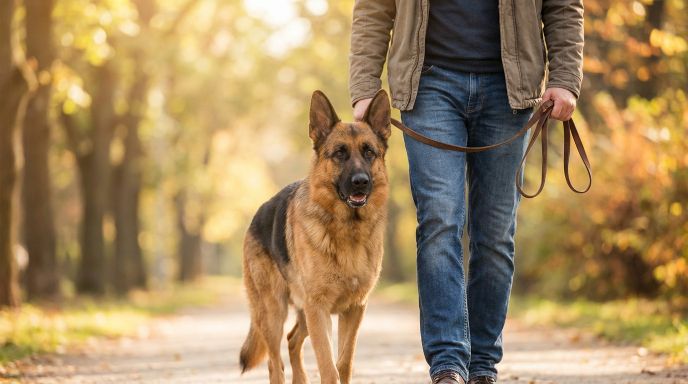
Have you ever felt like your German Shepherd is walking you instead of the other way around? You’re not alone. Picture this: You snap on the leash, open the door, and suddenly you’re being dragged down the sidewalk by 70 pounds of excited muscle and fur. Your shoulder aches, your arm feels ready to pop out of its socket, and you wonder—will walks ever be enjoyable again?
The good news? Yes, they absolutely will. German Shepherds are incredibly intelligent dogs, and with the right training approach, you can teach your GSD to walk politely on a loose leash. It takes patience and consistency, but the results are worth every minute.
This guide will walk you through everything you need to know about stopping leash pulling in German Shepherds. You’ll learn why your dog pulls, how to fix it step-by-step, and what to do when challenges pop up. Let’s turn those frustrating walks into the peaceful bonding time you both deserve.
- Why German Shepherds Pull on the Leash
- Before You Start: Essential Preparation
- The Complete 5-Step Loose-Leash Training Method
- Age-Specific Training Approaches
- Handling Common Challenges
- Common Mistakes That Make Pulling Worse
- Real-World Walking Strategies
- When to Seek Professional Help
- Tracking Your Progress
- FAQ: Leash Pulling Questions Answered
- Conclusion: Your Roadmap to Success
Why German Shepherds Pull on the Leash
Before we dive into solutions, let’s understand why your German Shepherd pulls. Understanding the behavior helps you address it more effectively.
Breed-Specific Reasons
German Shepherds weren’t bred to stroll leisurely down sidewalks. They were developed as working dogs—herding sheep, guarding property, and performing demanding jobs. This heritage means your GSD comes with some built-in challenges when it comes to walking calmly:
High Energy and Drive: German Shepherds have energy to spare. A casual walk feels painfully slow to a dog bred to work all day. If your GSD hasn’t burned off energy before the walk, pulling becomes an outlet for that pent-up drive.
Natural Working Instincts: GSDs love having a job to do. When they don’t have clear direction during walks, they’ll create their own job—usually “getting to that interesting smell as fast as possible.”
Intelligence: Here’s the double-edged sword. Your smart German Shepherd quickly learns that pulling works. If pulling gets them to the park faster, they’ll keep doing it. They’re smart enough to train you if you’re not careful!
Strength Advantage: Let’s be honest—German Shepherds are strong dogs. Even a moderately pulling GSD can make walks uncomfortable. This physical advantage means they can pull, so teaching them not to becomes essential.
Excitement and Curiosity: The world outside is endlessly fascinating to your GSD. Every walk brings new smells, sights, and experiences. That excitement can override their manners if they haven’t learned self-control.
When Pulling Typically Starts
Most leash pulling falls into one of these categories:
Puppy Behavior That Wasn’t Corrected: Many owners think, “My puppy is so small and cute, a little pulling doesn’t hurt.” Fast forward six months, and that cute puppy is now 60 pounds and pulling just as hard—except now it actually does hurt.
Adolescent Energy Surge (6-18 Months): German Shepherds go through an adolescent phase that can test any owner’s patience. During this time, energy levels skyrocket, attention spans shrink, and pulling often gets worse before it gets better.
Reinforced Behavior Over Time: Every time pulling “works”—meaning your dog gets to move forward while pulling—you’ve accidentally rewarded the behavior. Over months or years, this creates a deeply ingrained habit.
Why It Gets Worse
Your dog discovers it works: When pulling moves them toward what they want, the behavior gets reinforced. From your dog’s perspective, pulling is highly effective!
Inconsistency: Maybe you let them pull when you’re in a hurry, but expect perfect behavior on weekend walks. Dogs don’t understand “sometimes it’s okay, sometimes it’s not.”
Not enough exercise before walks: Trying to train a high-energy German Shepherd while they’re bursting with energy is like trying to teach a kindergartner math right before recess. It just doesn’t work well.
Now that we understand the “why,” let’s tackle the “how to fix it.”
Before You Start: Essential Preparation
Setting yourself up for success makes all the difference. Before you even step out the door, let’s get these foundations in place.
1. Pre-Walk Exercise
This might be the most important tip in this entire guide. A tired German Shepherd is a well-behaved German Shepherd—especially when it comes to leash manners.
Why it matters: Your GSD has energy that needs an outlet. If that energy doesn’t get released before the walk, it’ll come out as pulling, lunging, and general over-excitement. Think of exercise as taking the edge off so your dog can actually focus on training.
What to do:
- Play 15-30 minutes of fetch in the backyard
- Practice tug-of-war (great for bonding too!)
- Run through basic obedience commands for mental exercise
- Play hide-and-seek with toys or treats
- If you have space, let them run and play freely
Age guidelines:
- Puppies (under 6 months): 15-20 minutes of gentle play
- Adolescents (6-18 months): 20-30 minutes of moderate to vigorous play
- Adults (18+ months): 30-45 minutes of vigorous exercise
2. Choose the Right Equipment
Your equipment matters, but don’t fall into the trap of thinking special gear alone will solve pulling. Training is what works—equipment just makes it easier.
Standard flat collar: Fine for dogs who already walk nicely. For training a puller, you might need something more.
Front-clip harness: This can be helpful for strong pullers. When the dog pulls, the front clip naturally turns them back toward you instead of letting them drag you forward.
Important note about prong and choke collars: These tools can be effective in experienced hands, but they carry risks if used incorrectly. They can cause neck injury, trachea damage, or create negative associations with walks. We recommend starting with positive reinforcement methods first. If you’re considering these tools, please work with a certified professional trainer.
Gentle Leader (head halter): Some trainers recommend these, and they can help with control. However, some dogs strongly dislike the sensation of something on their face. Introduce gradually if you try this option.
4-6 foot leash: Perfect length for training. Avoid retractable leashes while training—they actually teach dogs that pulling extends the leash, which is the opposite of what we want!
For detailed reviews and comparisons of leashes, harnesses, and collars specifically tested for German Shepherds, visit GSDGearLab.com. For guidance on choosing the right equipment for your specific situation, check out SmartShepherdChoice.com.
3. Gather High-Value Rewards
Training requires motivation. You need rewards your German Shepherd actually cares about.
Food rewards: Small, soft treats that your dog can eat quickly. Good options include:
- Small pieces of cooked chicken
- String cheese (cut into tiny pieces)
- Hot dog slices
- Commercial training treats
Life rewards: These can be just as powerful as food!
- Permission to sniff an interesting spot
- Greeting another friendly dog
- Access to a favorite area
Praise: Don’t underestimate the power of your excited, happy voice telling your dog they’re wonderful!
Timing is everything: Rewards must happen immediately when your dog does the right thing. We’re talking within 1-2 seconds. Any longer, and your dog won’t connect the reward with the behavior.
4. Set Realistic Expectations
Let’s be honest about timelines so you don’t get discouraged.
Puppies (8 weeks – 6 months): You’ll see noticeable improvement in 2-4 weeks of consistent training. Puppies learn quickly, but they’re also easily distracted.
Adolescents (6-18 months): Plan for 4-8 weeks of consistent work. This is the most challenging age, so give yourself (and your dog) grace. Regression is normal during this period.
Adult dogs with established habits: If your adult GSD has been pulling for years, expect 2-3 months of consistent training to see major improvements. Old habits take time to change.
Daily commitment: Plan for 15-20 minutes of focused training during walks, every single day. Consistency matters more than length.
Remember: Progress isn’t always linear. You’ll have great days and frustrating days. That’s completely normal!
The Complete 5-Step Loose-Leash Training Method
Now for the heart of this guide—the actual training method. These five steps work together to teach your German Shepherd that loose leash = forward movement, and pulling = everything stops.
Step 1: Establish the Rule – No Pulling Allowed
This is your foundation. Your dog needs to learn one simple rule: tension on the leash means we stop moving.
Here’s exactly what to do:
- Attach the leash and step outside (after pre-walk exercise, remember!).
- Start walking at a normal pace.
- The instant your GSD pulls—and by “pulls” we mean the moment the leash gets tight—stop walking immediately. Plant your feet. Don’t move forward even an inch.
- Hold the leash firmly but don’t pull back. You’re not having a tug-of-war. You’re simply a tree that won’t budge.
- Wait. This is the hard part. Wait for your dog to look back at you, take a step toward you, or do something that creates slack in the leash.
- The second the leash goes slack, mark the moment with a cheerful “Yes!” or click if you’re using a clicker.
- Reward immediately with a treat or praise.
- Resume walking.
- Repeat this process every single time pulling occurs—and in the beginning, that’ll be often!
Why this works:
Your dog learns through consequences. Right now, pulling is rewarding because it moves them toward interesting things. By stopping every time they pull, you remove that reward. Pulling no longer works. Instead, a loose leash becomes the key that unlocks forward movement.
Common mistakes to avoid:
❌ Moving forward while the dog is pulling – Even one step teaches them pulling works sometimes.
❌ Waiting too long to reward – The moment matters! Reward within 1-2 seconds of slack.
❌ Inconsistent application – You must do this every single time, even when you’re tired or in a hurry.
❌ Getting frustrated – Your dog picks up on your emotions. Stay calm and patient.
GSD-specific tips:
✅ German Shepherds are highly intelligent. They typically catch on to this pattern within just a few days. The challenge isn’t them understanding—it’s their impulse control!
✅ Your first few walks might be painfully slow. You might stop every three steps. That’s okay! You’re laying the foundation. Stick with it.
✅ GSDs respond well to clear, consistent rules. Once they understand what you want, they’re usually eager to comply.
Step 2: The “Red Light, Green Light” Technique
Think of this as an extension of Step 1, but with a clearer mental framework.
The method:
Imagine you’re playing that childhood game “Red Light, Green Light.”
- Green light (GO): Walk when the leash is loose
- Red light (STOP): Stop immediately when dog pulls
- Stand still until slack returns
- Green light (GO): Reward and continue walking
What to expect week by week:
Week 1: You’ll feel like a human stop sign. You might walk three steps, stop, walk two steps, stop, walk four steps, stop. This is progress, even though it’s frustrating.
Week 2: You’ll start seeing longer walking intervals. Maybe you make it ten steps, then fifteen, then twenty before needing to stop.
Week 3-4: Noticeable improvement! Your German Shepherd starts checking in with you more often. You’ll actually cover ground during your walks again.
Patience is key: You’re reprogramming months or years of learned behavior. It takes time, but it absolutely works if you stay consistent.
Troubleshooting:
Problem: My dog won’t return their attention to me when I stop.
Solution: Make a noise to get their attention—a kissy sound, their name, or a gentle “hey!” If they still ignore you, take 2-3 steps backward. This usually catches their attention and brings them back toward you.
Problem: My dog just sits down and refuses to move.
Solution: Actually, this is good! It means they’re thinking about the situation. Wait them out. Eventually curiosity or desire to continue will win. When they stand and look at you, jackpot reward and continue.
Problem: We’re stopping SO many times. Am I doing something wrong?
Solution: Nope! You’re doing it right. Frequent stops at the beginning are normal and expected. This is the learning phase. Each stop is a teaching moment.
Step 3: Add the “Heel” or “With Me” Command
Once your dog understands that pulling stops movement, it’s time to add a command that tells them exactly where you want them to be.
Choose your command:
Pick one phrase and stick with it. Good options:
- “Heel”
- “Close”
- “With me”
- “Let’s walk”
Here’s how to teach it:
- Start in a quiet place with minimal distractions—your backyard or quiet street.
- Wait for your dog to be in the correct position: shoulder roughly aligned with your leg, leash loose.
- Say your command (“Heel”) only when they’re already in that position.
- Immediately reward with a treat right next to your leg.
- Take a few steps and reward again if they stay in position.
- If they drift out of position, stop walking. Don’t repeat the command. Wait for them to return to position, then reward and continue.
- Practice in 5-10 minute sessions.
Important: Only say the command when your dog is doing it correctly. If you repeat “heel, heel, heel” while they’re out in front pulling, you’re teaching them that “heel” means “pull ahead and ignore me.” Not what we want!
Position guide:
- Dog’s shoulder aligned with your leg (typically your left side, but either works)
- Leash has slack—it should hang in a loose “J” shape
- Dog is paying attention to you, not fixated on surroundings
Training tips:
✅ Use really high-value rewards initially ✅ Reward frequently at first (every few steps) ✅ Gradually increase the time between rewards ✅ Practice in different locations as your dog improves ✅ Keep sessions short and upbeat
Step 4: Introduce Direction Changes
Now we add an element that keeps your German Shepherd engaged and paying attention: unpredictability!
The method:
- While walking, when your dog starts to pull, silently turn 180 degrees and walk in the opposite direction.
- Don’t announce the turn. Don’t say their name or give warning. Just turn.
- When your dog catches up and walks nicely, praise and reward.
- Vary your turns: left turns, right turns, U-turns, zigzags. Be pleasantly unpredictable.
- Your dog can’t predict your movements, so they’re forced to pay attention to where you’re going.
Why this works:
Pulling becomes pointless if you might turn around at any moment. Your dog learns that the fastest way to get anywhere is to watch you for direction.
Plus, it creates a sort of “game” mentality. Your German Shepherd is engaged and thinking, “Where is my person going next?” That mental engagement reduces pulling born from boredom or distraction.
GSD-specific application:
German Shepherds are problem-solvers. Once they figure out “Oh! If I watch my person, I don’t get yanked backward!” they typically adapt quickly. This method appeals to their intelligence.
It also provides mental stimulation during walks, which German Shepherds crave. A mentally tired GSD is just as well-behaved as a physically tired one!
Step 5: Reward “Check-Ins”
This final step builds on everything else and creates a dog who naturally pays attention to you during walks.
What’s a “check-in”? It’s when your dog voluntarily looks at you during the walk, even if just for a moment.
The method:
- While walking, the instant your dog looks at you voluntarily, mark it with “Yes!” and reward.
- Even if you’re mid-stride, stop and make a big deal about it. “Good girl! Such a good check-in!”
- Create unpredictability by randomly calling your dog’s name. When they look at you, jackpot reward!
- Practice during walks—not just during training sessions, but on regular walks too.
- This builds a habit of your dog automatically checking in with you every so often.
Advanced technique:
Once your dog understands check-ins, you can start requiring eye contact:
- Say your dog’s name
- Wait for them to look at your face (not just your treat hand)
- Mark and reward the eye contact
- Practice until they automatically look at your face when you say their name
This becomes incredibly useful in distracting situations. “Fido!” followed by eye contact takes their attention off that squirrel or other dog.
Age-Specific Training Approaches
The approach that works for a 10-week-old puppy won’t be the same as what works for a 10-year-old adult. Let’s break it down by age.
Puppies (8 Weeks – 6 Months)
The good news: Puppies are blank slates! You can teach proper leash manners from day one, before bad habits form. Prevention is always easier than correction.
Training approach:
- Start immediately – Don’t wait until your puppy is “old enough.” Start the day they come home.
- Keep sessions short – 5-10 minutes max. Puppies have tiny attention spans.
- Reward heavily – Use a high rate of reinforcement. Reward every few steps of nice walking.
- Low-distraction environments first – Practice in your yard before hitting busy sidewalks.
- Combine with socialization – Puppies need to experience the world. Just do it while teaching manners!
- Be gentle – Use a regular flat collar or simple harness. No correction collars on babies.
- Make it fun! – Puppies should associate walks with joy, not stress.
What to expect:
✅ Quick learning – Puppies absorb information like sponges ✅ Short attention spans – Expect frequent distraction ✅ Lots of excitement – Everything is new and thrilling! ✅ Frequent breaks needed – Puppies tire quickly
Key insight: The habits you build now will last a lifetime. Invest the time in your puppy, and you’ll have years of enjoyable walks ahead.
Adolescents (6 Months – 2 Years)
The reality check: Adolescence is the most challenging phase for leash training. Your sweet puppy suddenly has the strength of an adult dog but the impulse control of a… well, a teenager.
What makes this age challenging:
- Energy surge – They have seemingly endless energy
- Increased strength – Now they can really pull
- Testing boundaries – “Do you really mean I can’t pull?”
- Distractions are more tempting – Hormones, curiosity, and high drive collide
- Selective hearing – They suddenly “forget” commands they knew perfectly
Training approach:
- Pre-walk exercise is NON-NEGOTIABLE – A tired adolescent is trainable; a fresh one is a tornado
- Consistency is critical – This is not the time to slack off
- Expect regression – Two steps forward, one step back is normal
- Be patient but firm – Clear rules help anxious adolescents feel secure
- Consider a front-clip harness – Can give you back some physical control during this phase
- Don’t give up! – This phase passes. Stick with training.
Common adolescent challenges:
“My 8-month-old was walking perfectly, and suddenly he’s pulling like crazy!”
This is incredibly common. Adolescent regression is normal. Don’t panic. Return to basics, increase rewards, and be consistent. They’ll come back around.
“My 1-year-old is so strong, I can barely hold on.”
Pre-walk exercise! Also, for very strong adolescents who are truly overpowering you, there’s no shame in seeking help. For severe pulling or leash aggression, professional guidance from RebuildYourShepherd.com can make a huge difference.
Adult Dogs (2+ Years)
The situation: Your adult German Shepherd has been pulling for years. The habit is deeply ingrained. Is it too late?
Absolutely not! Adult dogs can absolutely learn new behaviors. It just takes longer to override established habits.
Realistic timeline: Expect 8-12 weeks of consistent training before seeing significant, lasting improvement.
Training approach:
- Every walk is a training session – No more “just letting them pull this once”
- Higher value rewards – Adult dogs may need extra motivation
- Patience is essential – Progress will be slower than with puppies
- Consider professional help – A good trainer can accelerate progress significantly
- Address physical issues – Rule out pain or health problems that might cause pulling
Special considerations:
Health check: If your adult dog suddenly starts pulling when they didn’t before, or if they seem frantic/anxious during walks, rule out pain. Joint problems, vision changes, or other health issues can manifest as behavior changes. For guidance on joint health and mobility issues, visit ShepherdLongevity.com.
Fear or anxiety: Some adult dogs pull out of fear—trying to escape scary situations. This requires a different approach. If your dog shows signs of fear-based pulling (tucked tail, pinned ears, trying to flee), check out RebuildYourShepherd.com for specialized guidance.
The encouraging truth: Adult German Shepherds want to please you. Once they understand what you’re asking, most are happy to comply. The training investment absolutely pays off.
Handling Common Challenges
Even with perfect technique, you’ll encounter situations that test your training. Here’s how to handle the most common challenges.
Challenge #1: Dog Pulls Toward Other Dogs
Why it happens: Your GSD is excited/curious about the other dog, or they’re uncomfortable and pulling to create distance.
Solution:
- Create distance – Cross the street or turn down a side street before your dog fixates.
- Practice “watch me” – Get their attention before they lock onto the other dog.
- Reward heavily for looking at you instead of the other dog.
- Gradually decrease distance over many training sessions as your dog improves.
- Keep moving – Don’t stop and let them stare. Motion helps break fixation.
Important note: If your dog lunges, barks, or shows aggression toward other dogs, that’s leash reactivity—a separate issue that needs specialized help. Visit RebuildYourShepherd.com for guidance on addressing serious leash reactivity.
Challenge #2: Dog Pulls at the Start of Every Walk
Why it happens: Your dog is bursting with excitement about the walk! The beginning is always the most challenging moment.
Solution:
- Practice door manners – Require a sit before you open the door.
- If pulling starts immediately, go back inside – Close the door and start over.
- Repeat until your dog can exit calmly.
- Don’t start the walk until calm – Stand still outside the door until pulling stops.
- Pre-walk exercise helps immensely with this issue.
Script for door manners:
- Leash your dog
- Approach door
- Ask for “Sit”
- Reach for doorknob
- If dog breaks sit, step back and repeat
- When dog holds sit, open door slightly
- If dog lunges, close door and repeat
- When dog holds sit with door open, say “Okay!” and exit
This takes patience the first few times, but most German Shepherds learn door manners within a few days.
Challenge #3: Dog Pulls Toward Squirrels, Cats, or Other Prey
Why it happens: German Shepherds have a natural prey drive. Small, fast-moving animals trigger instinctive chase behavior.
Solution:
- Increase distance from the trigger – The farther away, the easier it is for your dog to control themselves.
- Higher-value rewards – You need rewards more exciting than the squirrel!
- Practice “leave it” separately – This command is invaluable for prey-drive moments.
- Redirect attention immediately – The second you spot the squirrel (before your dog does), get their attention with a happy voice and treats.
- Manage the environment initially – Choose routes with fewer squirrels while training.
Reality check: Some German Shepherds have extremely strong prey drive. You may never have a dog who ignores squirrels, but you can have a dog who looks at you when you ask, even with a squirrel present.
For advanced prey drive management and training techniques, GSDSmarts.com offers specialized guidance on working with high-drive dogs.
Challenge #4: Strong, Adult Male German Shepherd
Why it’s challenging: Adult male GSDs can weigh 90+ pounds of solid muscle. If they pull with determination, they can overpower many owners.
Solution:
- Front-clip harness – This is the one situation where equipment really can help. The front clip redirects their momentum.
- Focus on training, not strength battles – You won’t out-muscle an adult male GSD. Smart training wins.
- Pre-walk exercise is absolutely critical – Tire them out first!
- Consider a professional trainer – No shame in getting help with a strong dog.
- Build “heel” position separately – Practice in low-distraction areas until it’s solid.
For equipment recommendations and reviews specifically tested with large, strong German Shepherds, visit GSDGearLab.com. For guidance on selecting the right tools for your situation, SmartShepherdChoice.com can help.
Challenge #5: Dog Pulls Worse on the Return Home
Why it happens: Your dog knows you’re heading home, and they’re either eager to get there or trying to extend the walk by slowing down.
Solution:
- Practice direction changes near home – Turn around several times as you get close.
- Vary your route – Don’t take the exact same path every time. Mystery keeps them engaged.
- Reward heavily for loose leash near home – This area needs extra reinforcement since your dog has strong feelings about it.
- Make returning home less predictable – Sometimes walk past your house, circle the block, then return.
- Practice training exercises near home – Stop and do sits, downs, or other commands. Keeps them focused on you.
Common Mistakes That Make Pulling Worse
Let’s talk about what not to do. These mistakes can sabotage your training without you realizing it.
Mistake #1: Inconsistency
What it looks like:
- Allowing pulling “just this once” when you’re in a hurry
- Different rules on weekdays vs. weekends
- One family member allows pulling while another doesn’t
Why it’s a problem: Dogs learn through consistency. If pulling sometimes works, your dog will keep trying. It’s like a slot machine—occasional rewards make the behavior stronger, not weaker!
Solution: Hold a family meeting. Everyone must follow the same rules, every single time, no exceptions. It only takes one person undermining the training to slow progress significantly.
Mistake #2: Inadequate Exercise Before Walks
What it looks like:
- Expecting perfect behavior from a dog with zero pre-walk exercise
- Using walks as your dog’s only exercise
- Training when your GSD is bursting with energy
Why it’s a problem: A high-energy German Shepherd needs an outlet. If they haven’t released that energy, it’ll come out as pulling, jumping, and over-excitement. You’re setting yourself up for failure.
Solution: Make pre-walk exercise a non-negotiable part of your routine. 20-30 minutes of play, training, or free running in a safe area before you start leash training.
Mistake #3: Using the Wrong Equipment
What it looks like:
- Using a back-clip harness on a strong puller
- Collar too loose or the wrong type
- Using a retractable leash for training
- Equipment that doesn’t fit properly
Why it’s a problem: Back-clip harnesses actually encourage pulling by positioning the clip right where sled dogs have their pulling harness! Retractable leashes teach dogs that pulling extends the leash. Wrong equipment makes training harder.
Solution: Use appropriate equipment for training. A 4-6 foot standard leash and either a flat collar or front-clip harness work well for most dogs. For detailed product reviews, visit GSDGearLab.com.
Mistake #4: Punishment-Based Corrections
What it looks like:
- Harsh jerks or “corrections” on the collar
- Yelling at your dog when they pull
- Showing frustration or anger
- Physical corrections
Why it’s a problem: Punishment damages your relationship with your dog and can create fear or anxiety around walks. Some dogs become more reactive and difficult to handle with punishment-based methods.
Solution: Stick with positive reinforcement. Reward what you want; remove rewards for what you don’t want (by stopping). This builds a dog who wants to walk nicely with you.
Safety note: Harsh collar corrections can cause serious physical injury, including tracheal damage, neck strain, and spinal problems. German Shepherds are strong—they can hurt themselves if they hit the end of a leash at full speed.
Mistake #5: Giving Up Too Soon
What it looks like:
- Training for a week, seeing slow progress, and quitting
- Getting discouraged after a few setbacks
- Expecting overnight results
Why it’s a problem: Behavior change takes time. Most owners give up right before they would have seen breakthrough progress!
Solution: Commit to at least 30 days of consistent training before evaluating. Keep a training journal so you can see progress that feels invisible day-to-day. Progress is happening—even when it doesn’t feel like it!
Mistake #6: Boring, Predictable Walks
What it looks like:
- Exact same route every single day
- No engagement with your dog during walks
- Ignoring your dog the whole time
Why it’s a problem: German Shepherds are intelligent dogs who need mental stimulation. If you’re boring, they’ll entertain themselves—usually by pulling toward interesting things!
Solution:
- Vary your routes frequently
- Practice obedience commands during walks
- Play games like “find it” (toss treats into grass to sniff for)
- Talk to your dog, engage with them
- Be the most interesting thing on the walk!
Real-World Walking Strategies
Let’s talk about making walks enjoyable once you’ve got the basics down.
Making Walks More Enjoyable
Sniff Breaks:
Don’t make every walk a strict training march. German Shepherds gather information through scent. Build in 2-3 designated spots where you give permission to sniff. “Okay, sniff time!” This serves as both a reward and mental enrichment.
Training Breaks:
Randomly stop and practice commands. “Sit.” “Down.” “Stay for 10 seconds.” Then continue walking. This keeps your dog engaged and attentive.
Vary Your Pace:
Don’t just walk at one speed. Speed up for 20 steps. Slow down. Stop suddenly. Keep your dog paying attention to you through unpredictability.
Change Routes:
New smells equal mental stimulation. Try different neighborhoods, trails, or areas. For daily lifestyle tips and creative walk ideas, check out RealGSDLife.com.
Walking in Different Environments
Quiet Neighborhoods: Perfect for training. Low distraction means your dog can focus on learning.
Busy Streets: More challenging. Expect more pulling attempts. Keep sessions shorter and reward frequently.
Around Dog Parks: High distraction! Leave this environment until your dog is solid with leash manners everywhere else.
Hiking Trails: Once your dog has mastered loose-leash walking, trails offer wonderful opportunities for both of you. You can allow more freedom while maintaining control.
When to Seek Professional Help
Sometimes, despite your best efforts, you need expert guidance. There’s absolutely no shame in getting help!
Signs You Need a Trainer
✅ Pulling causes you physical injury – Shoulder pain, wrist strain, or falls mean the situation has become dangerous.
✅ Your dog shows aggression on leash – Lunging, snarling, snapping, or biting directed at people or other dogs requires professional intervention immediately.
✅ No improvement after 4-6 weeks of consistent training – If you’re truly being consistent and seeing zero progress, a trainer can troubleshoot what’s not working.
✅ Your dog lunges at people, cars, or animals – This is dangerous and needs professional guidance.
✅ You feel unsafe or overwhelmed – Your mental health matters. If walks are causing you significant stress, get help.
✅ Multiple behavior issues beyond pulling – If leash pulling is just one of many problems, a comprehensive training program can address everything together.
What to Look For in a Trainer
- Certification: Look for CPDT-KA (Certified Professional Dog Trainer – Knowledge Assessed) or similar credentials
- Positive reinforcement methods: Avoid trainers who rely heavily on punishment or aversive techniques
- German Shepherd experience: Breed-specific knowledge is valuable
- Good reviews and references: Check online reviews and ask for references
- Comfortable communication style: You should feel heard and supported, not judged
Is It Worth the Investment?
Absolutely! Professional training:
- Protects your bond with your dog
- Prevents injury to both you and your GSD
- Provides faster results with expert guidance
- Addresses underlying issues you might not see
- Gives you confidence as a handler
For severe leash reactivity, aggression, or fear-based pulling that goes beyond basic training, RebuildYourShepherd.com specializes in rehabilitation and behavior modification.
Tracking Your Progress
It’s easy to feel like you’re not making progress when you’re in the thick of training. Tracking helps you see the improvement you’re actually making!
Success Indicators by Timeline
Week 1-2:
- Your dog looks at you more frequently during walks
- You notice occasional slack in the leash (even if brief)
- Your dog responds when you stop (even if slowly)
- You’re stopping slightly less often than Day 1
Week 3-4:
- Walking 10-20 feet without pulling
- Quicker recovery when pulling does occur
- Your dog checks in with you voluntarily sometimes
- Less frustration for both of you
Week 6-8:
- Consistent loose-leash walking for full blocks
- Your dog regularly checks in with you
- You can walk past some distractions successfully
- Walks are actually enjoyable!
Week 12+:
- Loose-leash walking is the default
- You can handle most distractions
- Your dog focuses on you even in exciting environments
- Walking together feels like partnership, not battle
Keep a Training Log
Document your journey! Each day, note:
- Date and duration of training walk
- Successes – What went well?
- Challenges – What was difficult?
- Environmental factors – Weather, distractions, time of day
- Notes – What worked? What didn’t?
This log helps you:
- See progress you might otherwise miss
- Identify patterns (does your dog pull more in the mornings? After certain meals?)
- Remember what techniques work best
- Feel encouraged on hard days
FAQ: Leash Pulling Questions Answered
Q: How long does it take to stop a German Shepherd from pulling?
A: With consistent daily training, expect:
- Puppies: 2-4 weeks to establish good habits
- Adolescents: 4-8 weeks for reliable loose-leash walking
- Adult dogs: 2-3 months for deeply ingrained habits to change
Remember, every dog is different. Your timeline might be faster or slower. The key is consistency, not speed.
Q: Should I use a prong collar on my German Shepherd?
A: Prong collars can be effective training tools when used correctly by experienced handlers. However, they’re not necessary for most dogs, and they carry risks if used improperly (neck injury, tracheal damage, negative associations).
We strongly recommend starting with positive reinforcement methods first. If you’re considering a prong collar, please work with a certified professional trainer who can teach you proper use. Improper use can cause physical injury and make behavior problems worse.
For equipment reviews and recommendations, visit GSDGearLab.com.
Q: My German Shepherd only pulls at the beginning of walks. Is this normal?
A: Yes, extremely common! Your dog is excited about the walk. The beginning is always the most challenging part because energy and excitement are highest.
Practice door manners, implement pre-walk exercise, and be extra patient for the first 5-10 minutes. Most dogs settle after that initial excitement burst.
Q: Will my German Shepherd ever walk nicely without constant training?
A: Yes! Once the behavior is solidly trained, loose-leash walking becomes a habit. You won’t need to actively “train” every second of every walk forever.
However, German Shepherds are strong, intelligent dogs. Without any training, pulling will likely develop or worsen. The good news: they’re smart learners! Once trained, most GSDs maintain good leash manners with just occasional reinforcement.
Q: Can I use a retractable leash while training?
A: Not recommended. Retractable leashes actually teach dogs that pulling = the leash extends, giving them what they want. This is the opposite of what we’re trying to teach!
Use a standard 4-6 foot leash for training. Once your dog has mastered loose-leash walking, you can consider a retractable for certain situations (like open fields), but not for regular walks.
Q: My German Shepherd walks perfectly at home but pulls in public. Why?
A: Different environments present different levels of distraction. Your home environment has minimal distractions—your dog has already explored every inch. Public spaces have endless new sights, smells, and sounds competing for their attention.
This is normal and expected! It’s why we start training in low-distraction areas and gradually increase difficulty. Think of it like learning math—you master addition at home before tackling calculus in a noisy classroom!
Keep training in public spaces. Reward more frequently there. With practice, your dog will generalize the behavior to all environments.
Q: Is a harness or collar better for German Shepherds?
A: It depends on your specific situation:
For training a puller: A front-clip harness can be helpful because it redirects your dog’s momentum when they pull, turning them back toward you instead of letting them drag you forward.
For trained dogs: A flat collar works fine once they’ve learned loose-leash manners.
What to avoid: Back-clip harnesses actually encourage pulling by positioning the attachment point where sled dogs have their pulling harness!
For detailed product reviews tested specifically with German Shepherds, visit GSDGearLab.com. For help choosing the right equipment for your situation, check out SmartShepherdChoice.com.
Q: Should I let my German Shepherd sniff during walks?
A: Absolutely! Sniffing is how dogs gather information about the world. It’s mentally stimulating and enriching.
The key is using sniffing as a reward. “Walk nicely for 20 feet, then you can sniff this tree.” This teaches your dog that loose-leash behavior earns the privilege of exploring.
Don’t let your dog drag you to every smell. Instead, give permission: “Okay, sniff time!” This way you control when sniffing happens while still allowing your dog to enjoy walks.
Conclusion: Your Roadmap to Success
You’ve made it through this guide, and now you have all the tools you need to stop your German Shepherd from pulling on the leash. Is it going to happen overnight? No. But with patience, consistency, and the right approach, those frustrating walks will become the peaceful, bonding experience you’ve been dreaming of.
Let’s review your action plan:
Your Action Plan:
- ✅ Start with pre-walk exercise – 20-30 minutes of play before training walks
- ✅ Choose your equipment – Front-clip harness or flat collar + 4-6 foot leash
- ✅ Apply the stop-and-start method every walk – No pulling allowed, ever
- ✅ Reward loose-leash behavior heavily – Treats, praise, and life rewards
- ✅ Be consistent – Every walk is a training walk
- ✅ Track your progress – Keep a training log to see improvement
- ✅ Seek professional help if needed – No shame in getting support!
Remember:
Your German Shepherd is intelligent, capable, and wants to make you happy. They’re not pulling to be difficult—they just haven’t learned a better way yet. You’re teaching them now.
There will be frustrating days. There will be days when it feels like you’ve made zero progress. There will be days when you regress. This is all normal. Every German Shepherd owner who now enjoys peaceful walks went through the same process you’re going through right now.
Stay patient. Stay consistent. Celebrate small wins. And remember why you got a German Shepherd in the first place—these incredible dogs are worth the effort.
Before you know it, you’ll be walking down the street together, your GSD at your side with a loose leash, and you’ll think, “We did it. All that training was worth it.”
Because it absolutely is.
Ready to Take the Next Step?
Explore these resources to continue your German Shepherd training journey:
- Advanced training techniques: GSDSmarts.com
- Health and joint care: ShepherdLongevity.com
- Severe leash reactivity or aggression: RebuildYourShepherd.com
- Daily care and lifestyle tips: RealGSDLife.com
- Equipment selection guidance: SmartShepherdChoice.com
- Product reviews and testing: GSDGearLab.com
You’ve got this. Your German Shepherd has got this. Together, you’ll master loose-leash walking.
Happy walking! 🐕
🔗 Explore the German Shepherd Network
Need more specialized guidance? Our network of expert sites covers every aspect of GSD ownership: